


Table of Contents
Why Contractors Need a Smarter Financing Plan in 2026
You May Also Like
Talk to any contractor who has been around for a while and they will tell you the same thing: the equipment does not pay for itself until it is working, and it cannot work if you do not have it. Construction equipment financing is not just about buying a machine. It is a cash flow decision, a growth decision, and a risk management decision wrapped into one.
Get the structure right and you can add capacity without gutting the money you need for payroll, insurance, fuel, repairs, permits, and day-to-day operations. Get it wrong and a payment that looked manageable on closing day can become a real problem the moment revenue slows, maintenance climbs, or a customer delays payment.
A few 2026 reference points worth knowing: the IRS lists the Section 179 maximum deduction at $2,560,000, with phase-out beginning after $4,090,000 in qualifying property placed in service. The Federal Reserve Bank of St. Louis shows the bank prime loan rate at 6.75% as of May 2026, which influences many variable-rate business loans and SBA-related pricing. These are planning inputs, not personalized financial or tax advice.
What Construction Equipment Financing Actually Covers
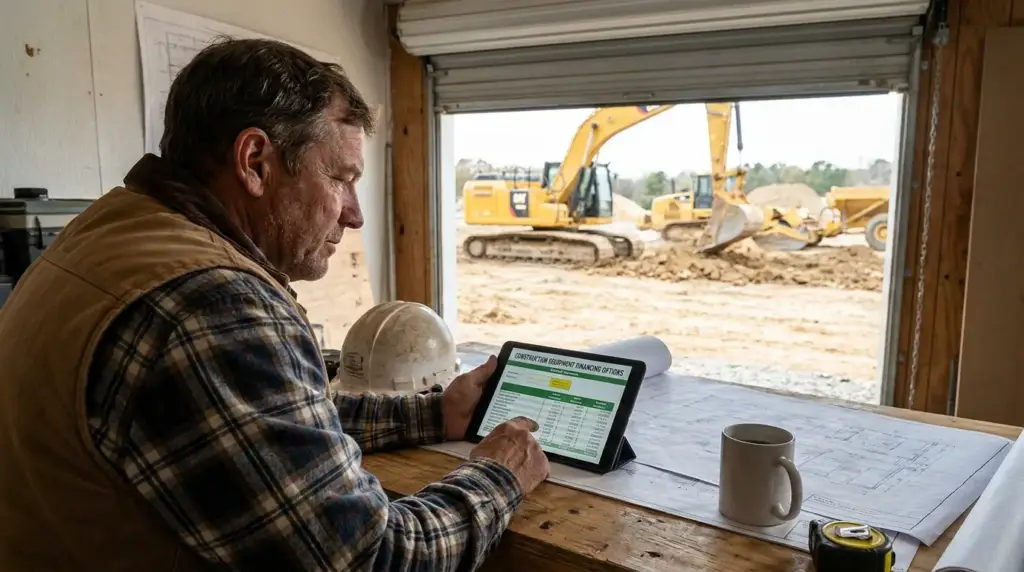
At its core, construction equipment financing is funding used to buy or lease a business asset, with the financed asset usually serving as collateral. If the borrower stops making payments, the lender may have rights to the equipment under the agreement.
The strongest applications share three things: the equipment fits the actual job, the borrower can clearly afford the payment, and the documentation tells a coherent story.
Equipment That May Qualify
Construction equipment financing can apply to excavators, skid steers, loaders, backhoes, bulldozers, cranes, concrete equipment, compactors, graders, and related attachments. Equipment with strong resale demand is easier to finance than highly specialized units with limited secondary market appeal.
New vs. Used Equipment
New equipment brings warranty coverage, lower early maintenance risk, updated technology, and a longer expected useful life. It also comes with a higher purchase price and more depreciation in the first years.
Used equipment can reduce upfront cost and make monthly payments easier to manage. Pay close attention to machine hours, maintenance records, and service history. A cheap unit that spends too much time broken down is not cheap at all.
How Lenders Review Your Application
Credit Profile
Credit tells the story of how you have handled debt in the past. Strong credit can improve your rate, lower your down payment requirement, and give you more flexibility. Weak credit does not always mean denial, but it tends to change the structure in ways that cost more. Do not hide credit problems. Lenders will find them, and unexplained issues create more distrust than the issues themselves.
Time in Business
A business with several years of operating history is simply easier to evaluate. Startups can still apply, but they need a stronger story. Industry experience becomes especially important when the business itself is young.
Revenue, Cash Flow, and Bank Statements
Revenue shows activity. Cash flow shows repayment ability. Bank statements matter because they show real deposits, cash movement, and how the business actually operates month to month. Before applying, calculate the expected payment and compare it against conservative revenue. Good financing should survive an ordinary slow month.
Equipment Age, Condition, and Resale Value
Lenders care about age, condition, hours, maintenance history, title status, and market value. If the equipment is used, get maintenance records, photos, inspection reports, and a clean invoice or purchase agreement.
Down Payment
A down payment reduces lender risk and lowers the amount financed. Strong borrowers may qualify with less. The important thing is not to drain every available dollar into the down payment and leave nothing for operations.
Funding Options Worth Comparing
Equipment Loans
Equipment loans are the most common option for buyers who want ownership. The lender funds the purchase, you make payments, and you own the asset outright once the loan is paid. This works well when the equipment is central to your long-term operations.
Equipment Leasing
Leasing gives your business access to equipment without the same ownership structure. It can work well for businesses that want lower upfront costs, regular upgrades, or equipment for a defined project cycle. Hour caps, wear rules, and early termination fees can significantly change the real cost.
SBA Loans and Bank Financing
The SBA 7(a) program can support equipment purchases along with working capital and other business needs. Bank and SBA financing may offer attractive terms for qualified borrowers, but they typically require more documentation and a longer timeline.
SBA 7(a) Loans: https://www.sba.gov/funding-programs/loans/7a-loans
Dealer or Vendor Financing
Dealer financing is convenient because the equipment and the money come from the same conversation. Always compare any dealer offer against at least one outside lender.
Working Capital Support
Working capital financing is usually not the right tool for buying a long-term asset. Where it can add value is in covering related operating costs while new equipment starts generating revenue.
2026 Cost Factors You Need to Understand
Interest Rates and APR
As of May 2026, FRED data shows the bank prime loan rate at 6.75%. APR, which may include certain fees, is often more useful for comparison than the stated rate alone. Ask for the total repayment amount on every offer.
Loan Term
A longer term reduces monthly payments but increases total interest. A shorter term costs less overall but puts more pressure on cash flow. The term should match the equipment’s useful life.
Fees, Insurance, and Operating Costs
Fees can include origination charges, documentation fees, title fees, broker fees, and closing costs. Insurance for construction equipment should be quoted before closing. Beyond financing, factor in fuel, maintenance, repairs, labor, compliance, and downtime.
Section 179 and Tax Planning
The 2026 Section 179 maximum deduction is $2,560,000, with phase-out beginning after $4,090,000 of qualifying property placed in service. Tax treatment depends on asset type, business use, taxable income, and placed-in-service timing. Talk to a CPA before closing.
IRS Publication 946: https://www.irs.gov/publications/p946
Step by Step Application Checklist
- Define the business purpose. Is this replacing aging equipment, supporting a new contract, reducing rental costs, or expanding capacity?
- Estimate revenue and costs. Include the payment, insurance, fuel, maintenance, labor, permits, and expected downtime.
- Check your credit and fix errors before applying.
- Gather documents: bank statements, tax returns, financial statements, business formation documents, equipment invoice, insurance quotes, and ID.
- Choose the asset carefully. It should match the work, the budget, and the expected term.
- Compare at least two or three financing offers. Review total repayment, not just monthly payment.
- Read the full agreement before signing.
How to Improve Approval Odds
Make the lender’s job easier. Provide organized documents and a clear explanation of how the equipment will generate income.
Show consistent deposits and responsible cash management. Avoid overdrafts where possible.
Choose equipment with strong resale value and clean documentation.
If your business is new, lean on your industry experience, existing contracts, and a conservative operating plan.
If credit is weak, do not pretend otherwise. Explain the issue, show recovery, and strengthen the rest of the application.
Mistakes That Hurt Cash Flow
Shopping only by monthly payment. A low payment can conceal a long term, heavy fees, and a much higher total cost.
Buying too much equipment too soon. Growth requires capacity, but capacity without demand becomes an expensive burden.
Ignoring repairs and downtime. Construction is hard on machines. Budget for it before you sign.
Failing to compare multiple offers. The first approval is rarely the best offer.
Using all available cash at closing. Reserves protect the business when the unexpected happens.
Financing for Startups, Limited Credit, and Challenged Credit
Startups and borrowers with challenged credit can still qualify, but expect more scrutiny. A lender may ask for a larger down payment, stronger personal credit, proof of industry experience, contracts, or a lower-risk asset.
Bad-credit financing can be useful. It can also be dangerous if the payment does not fit real cash flow. Sometimes the right move is to delay the purchase, build cash reserves, improve credit, and apply from a stronger position.
A Practical Example
A contractor is considering equipment financing for a new excavator. Two offers come in. One has a very low monthly payment with a long term. The other has a slightly higher payment, a shorter term, and lower total repayment.
After reviewing total cost, expected maintenance, and cash reserves needed for operations, the contractor realizes the cheaper-looking offer keeps the business in debt longer than the machine’s strongest earning years. The final choice leaves enough cash for insurance, repairs, and the inevitable slow month. That is the right mindset.
Frequently Asked Questions
What is construction equipment financing?
It is financing used to buy or lease a business asset, usually with the equipment serving as collateral. It helps spread the cost over time instead of paying the full amount upfront.
Is it better to finance or lease?
Financing may be better if you want ownership and long-term control. Leasing may be better if you want flexibility, lower upfront costs, or regular upgrades.
Can startups qualify?
Yes, but approval may be harder. Startups often need strong personal credit, industry experience, a larger down payment, or proof the asset will generate revenue.
Can I qualify with bad credit?
Some lenders work with challenged credit. Expect higher rates, larger down payments, or stricter conditions.
Does Section 179 apply?
Some qualifying business equipment may be eligible, but eligibility depends on IRS rules and your specific tax situation. Talk with a CPA before relying on any deduction.
What matters most to lenders?
Repayment ability, credit history, cash flow, time in business, equipment value, down payment strength, and whether the asset clearly fits the business purpose.
Final Takeaway
Construction equipment financing can be a smart way to grow, replace aging machines, or add capacity without draining cash. But it only works when the payment fits the business.
Compare offers, review total cost, inspect the asset, understand the tax rules, and keep enough cash for operations after closing. A good financing decision should give your business more confidence to operate and grow, not create a payment that has you holding your breath every month.
